


Most discussions around SAP CPQ integration focus on connectivity, how CPQ links to CRM, how it integrates with ERP and how billing or commerce platforms fit into the wider picture. But in practice, those connections are rarely the root issue. The real challenge is ownership.
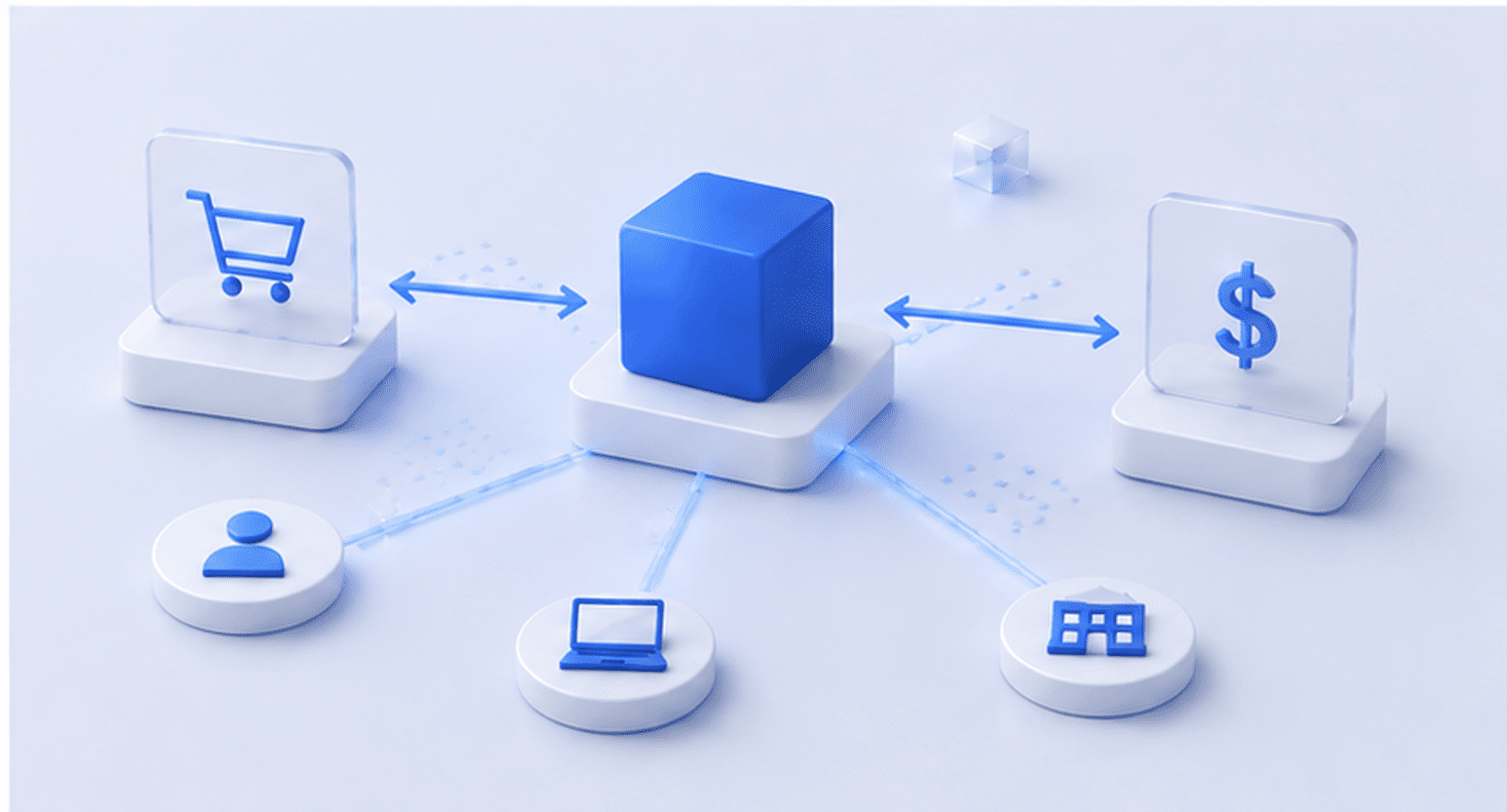
SAP CPQ sits within a broader quote-to-cash landscape that spans multiple systems and teams. CRM manages early-stage sales activity, ERP handles fulfillment and financial processing, and billing platforms manage revenue over time. CPQ sits between them, translating commercial intent into structured quotes.
When these responsibilities are not clearly defined, systems begin to overlap. Logic is duplicated, decisions are split across tools, and CPQ gradually takes on work that was never intended to sit within it.

The simple model most teams assume
At a high level, the division of responsibility across systems appears straightforward. CRM systems manage the early stages of the sales cycle, including opportunity tracking, customer engagement history, and pipeline forecasting.
Once an opportunity progresses, CPQ takes over to structure the commercial proposal, configuring products and preparing the quote for negotiation. When that quote is accepted, responsibility shifts to ERP, where orders are created and operational and financial processes are executed.
This model is intuitive because it reflects a clean progression from opportunity to quote to order. It makes perfect sense on paper, but it rarely holds true in practice, and here’s why.
Where this model stops working
In real-world implementations, the boundaries between systems are not fixed. They shift depending on how the business operates and what is being sold.
CRM and CPQ operate as part of the same sales loop
Although CRM is often described as ‘owning’ the opportunity and CPQ the quote, the transition between the two is rarely that straightforward.
Sales teams move back and forth between systems as deals evolve. Opportunity details are refined, pricing is adjusted, and scope is revisited during negotiation. At the same time, CRM continues to play a role after the initial sale, supporting upsell activity and customer analytics
As a result, CPQ operates within an ongoing sales loop, where information and decisions flow in both directions, rather than within the CRM.
The boundary between CPQ and ERP is inherently flexible
The distinction between CPQ and ERP is often described as: CPQ handles the quote and ERP handles the order. While directionally correct, this view overlooks how flexible, and often ambiguous, that boundary is in practice.
Pricing is a good example. Base pricing may be defined in ERP, while CPQ applies discounts, bundles, and deal-specific adjustments. In some cases, contract terms or subscription models introduce additional layers of pricing logic.
Similarly, product configuration may sit in ERP for manufactured goods, while CPQ manages service-based or bundled offerings. This creates situations where neither system is the single source of truth. Instead, ownership is shared, and logic is distributed across multiple platforms.
That flexibility can be useful, but it introduces risk. When responsibilities are not clearly defined, inconsistencies emerge and CPQ is forced to reconcile them during the quoting process.
Subscription models introduce a different kind of boundary
The traditional quote-to-order model assumes a single transaction. Subscription and usage-based models do not follow that pattern.
In these cases, CPQ is still responsible for defining pricing and commercial terms during negotiation. However, once an agreement is reached, billing systems take over to manage consumption and recurring invoicing.
The relationship between systems becomes less linear, the more distributed they get. A quote may lead to a contract rather than a one-time order, and changes to that contract, upgrades, downgrades, or cancellations, may be initiated in CPQ but executed in the billing system.
This introduces a different type of dependency, where CPQ defines the commercial structure, but financial execution happens elsewhere over time.
Commerce platforms extend the ecosystem further
Commerce platforms introduce yet another layer, particularly in organizations that support self-service purchasing or distributor-led sales.
Unlike CPQ, which is designed for internal users, commerce platforms are customer-facing. They allow users to browse products, configure orders, and initiate purchases directly. CPQ can support these workflows, either by acting as a backend configuration and pricing engine or by enabling sales-assisted processes that originate in commerce.
However, the two systems serve fundamentally different roles. CPQ is not a self-service portal, and treating it as one often leads to unnecessary complexity. Instead, it functions as part of a broader ecosystem, supporting structured sales processes alongside customer-facing tools.
CPQ/ERP boundaries are more strategic than technical
At this point, the challenge is no longer about how systems connect. It is about how responsibilities are defined across them.
When boundaries are unclear, pricing and configuration logic begin to overlap. Multiple systems attempt to act as sources of truth, and approval processes expand to compensate for the resulting inconsistency. CPQ, positioned between these systems, becomes responsible for coordinating decisions rather than simply structuring them.
This is often where performance issues begin, slowing down sales and blurring lines between different systems and S/4HANA.

What does effective SAP CPQ integration look like?
The difference between systems that scale and those that slow down is not how many integrations exist, but how clearly responsibility is defined across them. When ownership is unclear, pricing, configuration, and commercial logic become distributed across systems, and CPQ is left to reconcile them during the quoting process.
This is not just a technical issue. Manual and distributed pricing approaches are known to introduce inconsistencies, delays, and rework in complex environments. Research shows that 42% of companies experience revenue leakage due to disconnected quote-to-cash systems, with losses ranging from 3–7% of annual revenue.
Effective integration addresses this by aligning ownership across four key areas.
One pricing source of truth
In well-structured environments, pricing is not arbitrarily split across systems. There is a clear distinction between where pricing is defined, where it is applied, and where it is executed financially.
This may still involve multiple systems, for example, ERP governing core product pricing while CPQ manages services or deal-specific adjustments. But the model is consistent.
When that consistency is missing, CPQ becomes responsible for reconciling differences in real time. This leads to slower quote generation, increased approvals, and repeated revisions. In contrast, a clearly defined pricing model allows CPQ to apply logic predictably, without acting as a validation layer.
Effective configuration
Configuration reflects how the business actually operates, it should mirror how products and services are structured operationally, rather than attempt to replicate every possible scenario inside CPQ.
In effective architectures, structural product constraints typically sit in ERP or upstream systems, while CPQ applies commercial configuration logic for selling. This keeps the system aligned with how products are delivered and avoids duplication.
As product and pricing models grow in complexity, loosely defined configuration quickly becomes unmanageable. The goal is alignment over completeness, ensuring that what is configured in CPQ can be executed downstream without reinterpretation.
Handoffs between systems are clean and predictable
A well-structured CPQ implementation produces outputs that downstream systems can consume directly. Orders don’t need to be revalidated, pricing does not need to be corrected, and products do not need to be reconfigured after the quote is accepted.
Where this boundary is unclear, delays emerge quickly. Systems override each other, manual checks increase, and internal teams are forced to resolve mismatches. Research into CPQ delivery consistently highlights that fragmented systems and unclear handoffs slow processes and reduce reliability. A clean handoff removes that friction and allows execution to begin immediately.
CPQ remains a decision layer
At its best, CPQ is a decision layer, guiding configuration, pricing and commercial structure during the sales process.
It is not designed to coordinate logic across systems or resolve inconsistencies between them. When it is forced into that role, performance becomes dependent on multiple upstream and downstream dependencies, and complexity increases.
Keeping CPQ focused on its intended purpose ensures that it supports the sales process rather than compensating for architectural gaps.

A practical checklist for SAP CPQ integration
The impact of getting this right is measurable. Organizations with well-structured CPQ processes see 15–25% higher quote-to-order conversion rates, reflecting the effect of consistent pricing, clearer ownership, and reduced friction in the sales process. A well-structured CPQ environment can usually be identified through a small number of questions:
- Is there a clearly defined source of truth for pricing?
- Is configuration ownership aligned with how products are delivered?
- Do downstream systems execute CPQ outputs without reinterpretation?
- Are approvals used for exceptions, rather than as a default control?
- Can changes be made without coordinating across multiple systems?
- Do sales teams trust the system enough to rely on it fully?
If these questions are difficult to answer, the issue is unlikely to be integration itself. It is a sign that boundaries between systems are not clearly defined and that CPQ is being asked to do more than it should.
CPQ depends on the systems around it
SAP CPQ does not operate in isolation. It relies on CRM for context, ERP for execution, billing systems for revenue management, and commerce platforms for customer interaction.
When these systems are aligned, CPQ enables faster and more consistent quoting. When they are not, it becomes the point where misalignment is exposed.
That’s why integration alone is not enough. What matters is how the system is structured. CPQ does not simplify your architecture. It reveals whether your architecture makes sense.