


SAP has made a landmark reversal: Joule AI agents – previously reserved exclusively for Cloud customers – will now be extended to SAP ECC and on-premise S/4HANA environments. We break down what changed, who qualifies, what the conditions are, and how CLARITY is already delivering AI agent capabilities to ECC clients today.
Key Takeaways:
- SAP reversed its cloud-only AI stance at Sapphire 2026, announcing Joule AI agents for ECC and on-prem S/4HANA
- Access requires committing the majority of your landscape to RISE with SAP and signing up for the Max Success Plan
- SAP’s CEO Christian Klein confirmed this as an “interim solution” to unlock AI value during the migration journey
- CLARITY already provides AI agents natively integrated with SAP ECC – no cloud migration prerequisite required

SAP’s Historic U-Turn: AI for On-Prem Is Now Real
For years, SAP held a firm line: artificial intelligence, and specifically its Joule AI platform, was a cloud-first – and effectively cloud-only – proposition. If you were running SAP ECC or on-premise S/4HANA and wanted access to the new generation of AI assistants and agents, the answer was simple: migrate first, innovate later.
That position is now officially over.
At its annual Sapphire conference in May 2026, SAP announced a pivotal strategic shift. The company unveiled the SAP Business AI Platform – a new umbrella for its AI capabilities – and confirmed that a significant portion of its Joule assistants and agents would be extended to on-premise environments, including legacy SAP ECC systems.
This is not a minor product update but a direct acknowledgment that SAP’s enormous installed base of on-premise customers cannot be left behind in the AI era and that expecting them to wait years for a full cloud migration before touching AI was untenable.
What SAP Actually Announced
SAP’s executive board member for product and engineering, Muhammad Alam, told at the Sapphire conference that the company would bring a significant share of Joule assistants and agents to work in hybrid landscapes, with the ability to connect directly to on-premise S/4HANA and ECC systems. The offer, he confirmed, is available to customers who have begun their modernization journey on RISE with SAP.
The new capability sits inside a bundle of services called the Business AI Platform, available through the Max Success Plan – a commercial tier that customers must sign up for. SAP’s stated goal is to let customers “start generating value from AI today on the SAP Business AI Platform while modernizing their estate.”
For ECC customers still running mission-critical workloads on-premise, the announcement is significant. SAP stated that S/4HANA on-premises and SAP ECC customers who commit to transitioning the majority of their current landscape to SAP Cloud ERP will gain access to select AI scenarios, explicitly described as “bridging the gap between their current landscape and their cloud destination.”
WHAT’S INCLUDED IN THE BUSINESS AI PLATFORM
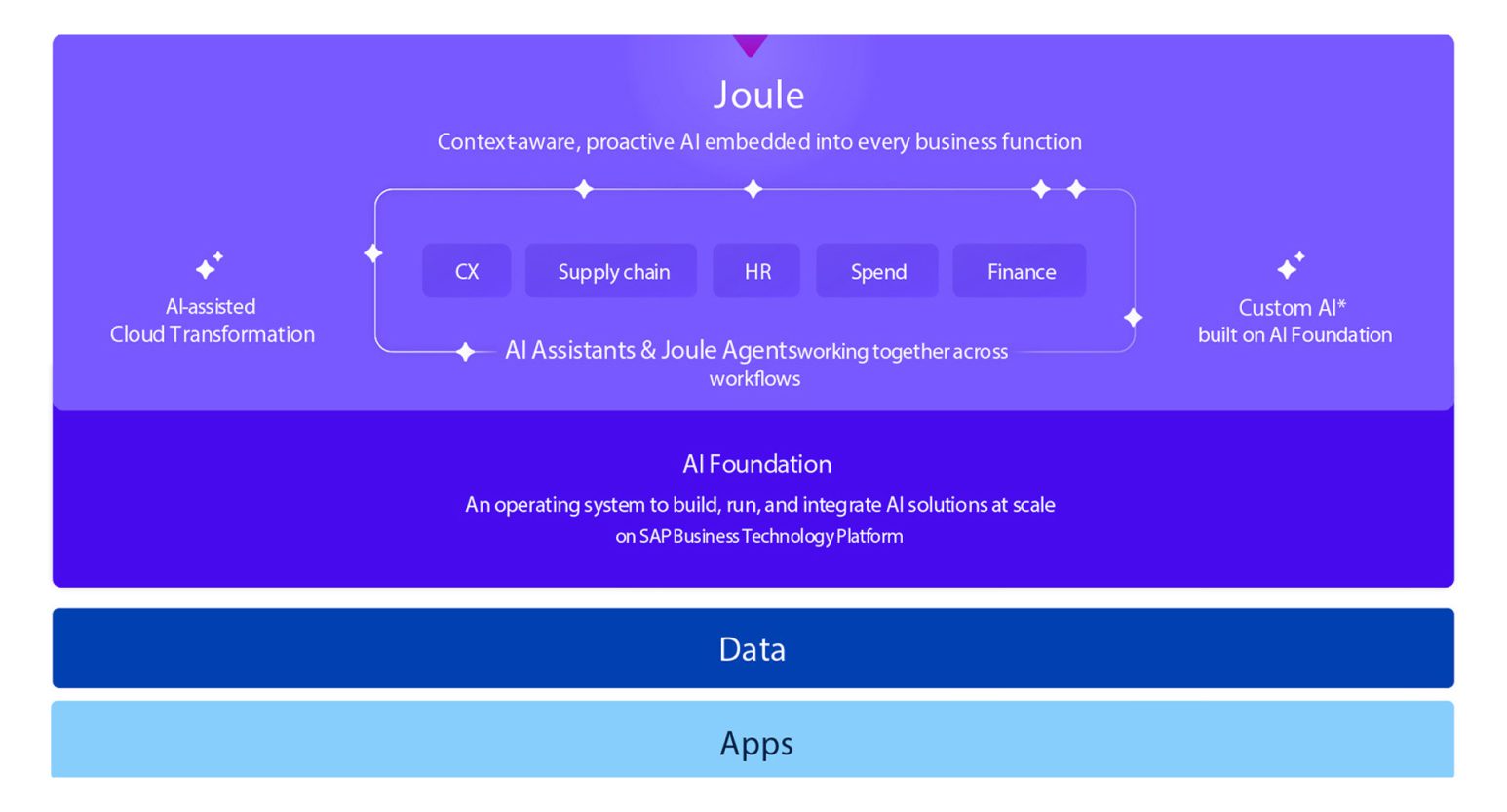
The new platform centers on Joule Work – a unified AI hub accessible across desktop, web, and mobile – as well as the SAP Knowledge Graph, which gives AI agents a structured map of business entities, processes, and relationships across your SAP landscape. Joule Studio, SAP’s agent builder, became generally available in Q1 2026.
Christian Klein’s Confirmation: In His Own Words
The majority of our Joule assistants and agents [will be available] also on-prem, on ECC, and S/4HANA for customers that have already committed the majority of the landscape to the journey, as an interim solution so that they can benefit from AI while they are modernizing. That’s absolutely the right thing to do, and I’m excited to see customers taking advantage of this.
Klein’s framing is important: this is positioned as an “interim solution” – a bridge, not a permanent alternative to cloud migration. But for the thousands of organizations running core business processes on ECC, the ability to deploy AI agents without waiting for a full migration is transformative in practical terms.
Who Qualifies? Understanding the Conditions
This is where ECC customers need to read the fine print. SAP’s AI access for on-premise systems is real, but it comes with meaningful eligibility conditions. Not every ECC customer will automatically qualify.
| CLOUD COMMITMENT You must have converted more than 50% of your maintenance to the cloud under RISE with SAP | COMMERCIAL PLAN Access requires enrollment in the Max Success Plan – a specific commercial tier |
| MIGRATION JOURNEY Your organization must be actively on a documented modernization journey to SAP Cloud ERP | AVAILABILITY General availability was planned for May 2026, with rollout ongoing for qualifying customers |
In practice, this means organizations that have committed to RISE with SAP but haven’t yet completed their migration – a position many mid-to-large enterprises find themselves in – are the primary beneficiaries. Pure on-premise holdouts with no cloud commitment will not qualify under SAP’s native program.
The Scale of SAP’s On-Prem Installed Base
SAP’s reversal didn’t happen in a vacuum. The company had been tracking a significant gap between its targets for migrating customers to the cloud and actual on-premise support revenue – reportedly around €2 billion off target. With mainstream maintenance for ECC 6.0 locked in at December 31, 2027, the pressure on both SAP and its customers has been intensifying.
There are thousands of organizations worldwide still running core ERP functions on SAP ECC. Many of these companies operate in sectors with long capital cycles, heavy customizations, and regulatory environments that make rapid cloud migration genuinely risky. Telling them they must fully migrate before touching AI was increasingly untenable, both commercially and strategically.
The Sapphire 2026 announcement reflects a pragmatic pivot: SAP wants to retain these customers, accelerate their journey, and give them a reason to stay within the SAP ecosystem rather than explore alternative AI-powered ERP platforms.
CONTEXT: ECC MAINTENANCE DEADLINE
SAP ECC 6.0 mainstream maintenance ends December 31, 2027. Extended maintenance options exist, but the AI access question adds a new dimension: ECC clients who want both continued support and AI capabilities now face a clearer decision point about their modernization roadmap.
Technical Realities: Why On-Prem AI Is Genuinely Complex
It would be misleading to present this as a straightforward unlock. SAP’s own product leadership has acknowledged the technical barriers involved. Cloud-based AI agents can access predictable, standardized data endpoints. On-premise systems (particularly older ECC installations) present a more heterogeneous picture: decades of customizations, bespoke data models, and complex integrations that don’t map neatly to the assumptions built into cloud-native AI agents.
The SAP Knowledge Graph is designed to help address this by building a semantic layer across the landscape. But for heavily customized ECC environments, the gap between what Joule can do natively and what your business actually needs may require additional integration work.
This is precisely why purpose-built AI agents with deep ECC integration, rather than cloud-native agents retrofitted for on-prem, remain critically important.
The New Paradigm: Users as Controllers of AI Workflows
Beyond the on-prem extension, SAP’s Sapphire announcements signal a broader shift in how enterprise AI is meant to work. Richard Grandpierre, VP of product management for SAP’s Business AI, described the change as a fundamental rethinking of how users interact with enterprise software. The user, he explained, becomes the controller of a process, orchestrating a fleet of assistants and agents that execute the work, rather than a manual task executor.
For SAP ECC environments, this paradigm is especially valuable. Finance teams running month-end close on ECC. Procurement teams managing purchase orders. HR functions handling payroll runs. These are process-heavy, repetitive workflows that are ideal candidates for AI automation, and they don’t need to wait for S/4HANA Cloud to benefit.
Don’t Wait for SAP’s Rollout: CLARITY Delivers AI Agents for ECC Today
CLARITY has been building and deploying AI agents specifically designed for SAP ECC and on-premise environments, through our broader AI transformation services practice. While SAP’s native Joule access for on-prem requires meeting strict eligibility conditions, our approach is different: we meet you where you are.
Our AI agents integrate natively with SAP ECC: connecting to your existing data, processes, and business logic without requiring a cloud migration as a prerequisite. Whether you’re modernizing, deferring migration, or running a hybrid landscape, our agents are designed to work in your environment, not the environment SAP wishes you were in.
- Native ECC integration: no RISE with SAP requirement
- Pre-built agents for finance, procurement, and sales workflows on ECC
- Our own proprietary AI agent framework developed specifically for on-premise SAP
- Hybrid deployment: works alongside SAP Joule when it becomes available on your system
- Rapid deployment: go from kickoff to live AI agents in weeks, not quarters
- No disruption to existing ECC customizations or integrations
What SAP ECC Clients Should Do Now
If you’re running SAP ECC, the Sapphire 2026 announcements are a signal, not a final solution. Here’s a practical framework for evaluating your position:
If you’re committed to RISE with SAP
- Assess whether your cloud conversion percentage meets the 50%+ threshold for Joule AI eligibility
- Engage your SAP account team about the Max Success Plan and what AI scenarios are available for your landscape
- Evaluate which Joule agents map to your actual ECC workflows and where gaps remain
- Consider supplementing with CLARITY agents for use cases not covered by Joule on ECC
If you’re still evaluating your migration path
- The AI access question is now a legitimate factor in your migration business case – quantify the value
- Don’t let the ECC AI gap slow your AI strategy; solutions exist today that work on your current landscape
- Explore CLARITY’s ECC-native AI agents as an immediate path to AI value while you plan your migration
- Factor the December 2027 maintenance deadline into your timeline, but don’t let it force a rushed decision
If you’re planning to extend ECC beyond 2027
- Extended maintenance options exist, but access to SAP’s native AI is tied to cloud commitment
- Third-party AI agent platforms with ECC integration – like CLARITY – provide AI access independent of your maintenance contract
- Evaluate the total cost of AI capability versus migration cost over a realistic 3–5 year horizon
CLARITY works with SAP ECC clients across industries to design, build, and deploy AI agents that integrate with their existing on-premise landscape. Our agents are in production on ECC systems today – handling financial reporting automation, procurement workflow intelligence, supplier risk scoring, sales documents automation and more. We’re not waiting for SAP’s rollout timeline.
The Bottom Line
SAP’s Sapphire 2026 announcement is genuinely good news for the ECC community. After years of being told that AI was a cloud-only proposition, on-premise customers now have a credible path – conditional, but real – to access Joule AI agents on their existing systems.
But the conditions matter. The 50%+ cloud conversion threshold, the Max Success Plan requirement, and the explicit framing as an “interim solution” mean that not every ECC customer will benefit immediately, and that SAP’s vision remains firmly cloud-directed.
For organizations that want AI agent capability on ECC now, without waiting for eligibility thresholds or migration milestones, CLARITY is already there. We’ve built the ECC integration layer, developed the agents, and have them running in production environments. The AI transformation of on-premise SAP doesn’t have to wait for SAP’s schedule.
Reach out to our team to see what AI agents on your SAP ECC system can look like today.